Saturday, August 21, 2010

Is there a floriographer in the house?

In my previous post I touched on the fact that flowers can have specific meanings. Floral symbols have been used by the ancient Greeks, early Chinese, Romans, Assyrians, Egyptians, and Indians, but the Victorian Era produced many books on the subject.

Also known as The Language of Flowers, floriography was a communication through flowers which allowed the expression of feelings that could not be spoken. In the Victoran Era, tussie mussies were the most popular way to send along a communication. Different flowers held different meanings, and it was possible to convey a lot through a variety of flowers in one bouquet.
However, it was important that the sender and receiver were both following the same dictionary, as there were differing ideas about what some flowers meant. A dictionary such as
The Language of Flowers by Kate Greenaway (1884) can still be found today.

One example I found is the meaning of a hugely popular flower, the Peony. It could mean "Happy Marriage" or "Good Fortune", but on the flip side it could mean "shame" and "bashfulness". Big difference, right?

It seems, though, that a red rose has the same meaning across the board. No wonder they are so popular still to send for Valentine's Day. No mixed signals there!

Wednesday, August 18, 2010

Why do we do it?

Sometimes I get to thinkin', which leads to questions, which if I'm lucky leads to answers...

Why do brides carry bouquets? I mean, they're pretty and all and look good in pictures, but why do we do it? What's the history? A quick Google search produced a few good theories, here are some satisfying answers:

The first recorded use of flowers in weddings dates to the ancient Greeks who considered them a gift from nature. Actually, the early "bouquets" were garlands worn on the heads of both bride and groom. Herbs such as rosemary and marjoram were common in the bridal crowns of Greek brides, as well as other herbs, bulbs and garlic.

rosemary
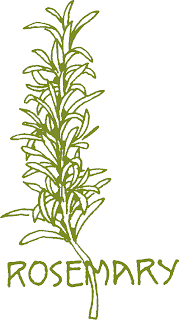


marjoram

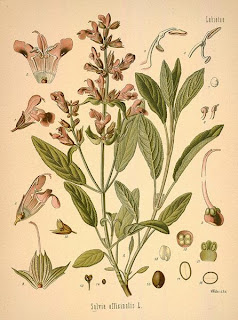
These elements were thought to ward off evil spirits. Nuts and grains symbolized fertility, happiness, and wealth. Dill was said to be the herb of lust and a bride would only lust after her husband if she carried dill and garlic together; Sage was believed to be an herb of wisdom and the bride who carried sage and garlic together was believed to learn goodness and gather great wisdom.

dill


sage
In the Celtic tradition, the bride and groom wore garlands made of ivy, herbs, and spices for protection.

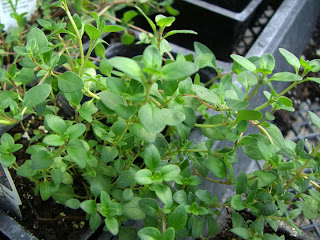
In Sweden, the groom traditionally carried thyme in his pockets and the bridesmaids carried bouquets of aromatic herbs to scare away any trolls.

thyme
It was not until the Victorian Era in England that bridal bouquets consisted entirely of flowers. Until modern times, a bride would choose her bouquet flowers based on symbolism, not on appearance.

Another common English tradition was for a flower girl to precede the bride on the pathway to the church, scattering flower blossoms; this was said to bless the bride with a lifetime of happiness and flowers.

And why do we throw petals (or blow bubbles, or light sparklers) as the bride and groom leave the reception? Another ancient wedding tradition was the throwing of confetti over the bridal couple. Confetti means sweets in Italian but it was common to throw rice, grain, nuts and sweets as well as more traditional flower petals as confetti; the throwing of confetti was meant to symbolize good luck, fertility, riches and sweet experiences for the bridal couple.

In India, the groom's brother scattered flower petals over the bridal couple at the end of the wedding ceremony to ward off evil spirits.

It seems as though flowers and herbs and most anything botanical were not only for looks, but were highly functional aspects of a wedding. Who wouldn't want to get as much good luck, happiness, and wealth as possible while discouraging evil spirits from tainting the marriage?


Saturday, August 7, 2010

August Lecture Series


There are several events that The Hambidge Center offers for fellows and visitors alike. The August Lecture Series began today and every weekend is something of interest. Here are a couple in the series:

On August 14 there will be a Late Summer Exploratory Wildflower Walk. This will take about 2 hours and is open to everyone. Learn about native plants, including orchids, that are blooming.


Image from www.hambidge.org

On August 28th is an informative session on beekeeping with Bob Binnie, voted the 2003 Georgia State Beekeeper of the Year by the Georgia State Beekeepers Association. He has been tending the bee hives at Hambidge for almost 15 years. Owner of the Blue Ridge Honey Company, Bob will discuss the fascinating art of beekeeping and answer all your buzzing questions.

Honeybees are responsible for around 80% of insect pollination. Without them, there would be a severe decline in fruits and vegetables. They are also the only insect that provides a food consumed by humans. And honey itself has vitamins, minerals, enzymes, and even an antioxidant that promotes improved brain function.We owe a lot to these busy little... well, you know!


The Hambidge Beehives


Inside the beehive at Osage Farms Market, just down the road from Hambidge


Town and Country

As much as I love the city of Atlanta, I love the fact that it's not a far drive from the peace and beauty of North Georgia. With several lakes, waterfalls, national parks and the eastern front of the Appalachian Mountains, known as the Blue Ridge Mountains, the northern part of the state has a lot to offer.


One truly magical spot is up 441, just a few miles before you enter North Carolina. Just after Rabun Gap-Nacoochee School and the Dillard House (yum!) is Betty's Creek Road on the left. 3.5 miles down is The Hambidge Center for Creative Arts and Sciences, where artists participate in residencies throughout the year. The mission is to provide the solitude, setting, and time necessary for creativity. Hambidge is a 600 acre tract of land with 9 cottage studios where fellows live and work for 2 to 8 weeks. The setting is pristine and provides a protected site for native plants and endangered species. In February 2009 I had the opportunity to attend this program and the experience is still fresh in my mind. Below are a few paintings I completed while there:AT ONE REMOVE


COUNTERFEIT INNOVATOR


PARTIAL VERDICT


ROOM TO BREATHE


Here's a shot of the studio that was my home:


I returned a few weeks ago to attend the Hambidge Hootin-N'anny, a green event that celebrated 75 years of the program. It was really something to see the place at the height of summer compared to the middle of winter. Both seasons do the setting justice!


Bluegrass at the Hootin-N'anny


As I write this I hear the sirens of firetrucks and car horns in Midtown. It's good to know that a quiet place is only 2 hours away!


Thursday, July 29, 2010

5 Million Dollar Baby

When you are in the business of weddings and you read about some of the more lavish celebrity celebrations, it can be a little fantastic to imagine oneself as a vendor for such an elaborate affair.

A few weeks ago it was Carrie Underwood's wedding at The Ritz-Carlton Lodge at Lake Oconee. With an estimated $500,000 price tag, the florals alone could have easily cost $50,000. She used a Nashville, TN florist, and while the style of flowers was not my particular taste, it sure is easy to appreciate the labor involved! Oh, and People Magazine reportedly paid $2 million for the photos.

Up next, Chelsea Clinton's Big Day:
Wedding of the Decade, Wedding of the Century, whatever you want to call it, the Clintonfest happening this Saturday will not be anything less than spectacular. Uncovering the juicy details is extremely difficult, as you can imagine.
We do know that the festivities will be held at Astor Courts in Rhinebeck, New York.

Astor Courts, image from the Astor Courts Website

I'm hoping for some good pictures of the decor, or at least a good shot of the bridal bouquet!

WEDDING COSTS- WHAT'S THE BREAKDOWN?

Okay, so maybe you don't have a few million, or even a few hundred thousand, to drop on this one day. And really, when all is said and done, you are getting married for more reasons than the opportunity to wear a veil. This is the beginning of your marriage, a long term union between you and your love.

Once the excitement of the engagement settles, it's time to start planning. First and most important is to determine what your budget is. There's no magic formula for that one, and every situation is different.

But there are some good resources out there to help you decide how to break down the cost of each part of the wedding. Not all experts will tell you the same thing, and that's okay. It also depends on what's important to you. Want to really do it up in the invitation department, but not too concerned about having an eight piece band? Go ahead, it is your big day after all.

REAL SIMPLE suggests the following:
  • Reception- 50%
  • Attire- 10%
  • Flowers and Decorations- 10%
  • Music- 10%
  • Photography/Videography- 10%
  • Favors and Gifts- 3%
  • Ceremony- 2%
  • Stationary- 2%
  • Wedding rings- 2%
  • Transportation- 1%
Here is their PDF worksheet, it provides more details on this breakdown.

MARTHA STEWART WEDDINGS uses this simple calculation:
  • Reception- 50%
  • Attire- 10%
  • Flowers- 10%
  • Music- 10%
  • Photography/Videography- 10%
  • Stationary, favors, other details- 10%
Here's Martha's worksheet in detail.

Obviously both resources in this case have similar suggestions. There are others out there if you want to look around!


Sunday, July 25, 2010

La Vida Local

As I mentioned in the previous post, I feel really good about being able to buy locally when it comes to flowers. Of course not everything I use comes from within a 200 mile radius, but in the summer especially it is a little easier to be green.


Above is an arrangement I created for Lauren Davenport, a gifted interior designer who has a knack for mixing antiques and flea market finds with a fresh, modern approach. The residence she designed in this photo is in the Luxe building in Midtown.


The hydrangea I used is locally grown, and has been blooming on plants that are over 80 years old! These plants were passed down on a property in Dacula, and my go-to guy at the flower wholesaler over the years bought up several of them from the owner to cultivate himself. There is really no way to say what exactly the variety is, but these hydrangea are my absolute favorite simply because they are strong, dry extremely well, and are a beautiful and subtle mix of greens, blues, and pinks. This crop will last probably through August, but the dried flowers will endure throughout the year.


Another green arrangement is a colorful mix of summertime flowers. With the exception of the zinnias, which were grown at Gilbert Farms in Cartersville, I cut everything from my parents' gardens.

Monday, July 19, 2010

Buy Local, Think Global


When you just want to go there, and by "there" I mean Italy, France, or any other amazingly beautiful European country, sometimes a mere flower arrangement can do the trick (however fleeting the moment may be!).
For a commercial client today I drew on my love for the mediterranean lifestyle and simply used sunflowers and olive branches. The sunflowers were grown locally at Gilbert Farms in Cartersville, Ga. The wholesaler has buckets and buckets of these symbols of summer, and it feels good knowing they came from fifty miles away. The resulting arrangement (below):


And now a close-up shows the tiny olives:


Sunflower arrangements always remind me of Dutch painter Vincent Van Gogh's series of paintings created during his time in Arles, France, in 1888.
Below is one titled "Still Life: Vase with Twelve Sunflowers". There are several still life sunflower paintings attributed to Van Gogh. This one is particularly appealing because the blue background resonates well with the flowers.


One of my favorite things about sunflowers is the curious way in which they grow directionally according to the sun. In the bud stage they exhibit heliotropism. At sunrise, the faces of most sunflowers are turned towards the east. Over the course of the day they follow the sun from east to west, while at night they return to an eastward orientation. Sunflowers in their blooming stage lose their heliotropic capacity and typically become "frozen" in an eastern-facing position.